
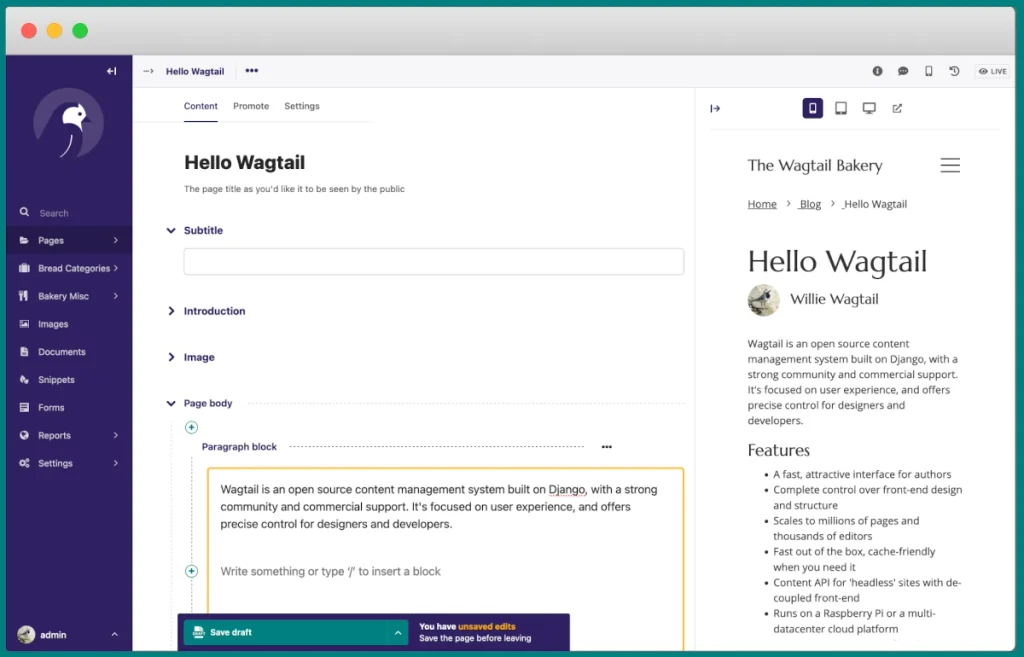
Wagtail CMS is a leading, enterprise-grade open-source content management system built on the Python programming language and the Django web framework. First launched in 2014 by Torchbox, a UK-based digital agency, Wagtail was engineered to provide developers with complete data model control while offering content editors a highly intuitive, uncluttered user interface. Over more than a decade, it has evolved from a boutique agency tool into a global standard powered by a massive contributor network, trusted by landmark institutions including Google, NASA, Mozilla, and the British NHS.
Key Milestone Timeline
- 2013–2014:
Torchbox originally developed the code under the moniker “Verdant” as a commissioned project for the Royal College of Art (RCA). Seeking a highly fast, customizable system that separated content layout from code logic, Torchbox officially released the source code to the public as Wagtail CMS in February 2014 under a liberal BSD license. - 2015-2017:
Wagtail 1.0 was launched, signaling maturity. Development quickly shifted from a single-agency effort to a democratic community framework, utilizing global coding sprints to shape the product roadmap. Reflecting its massive popularity in the Python ecosystem, the core development team expanded, and the main code repository officially migrated out of Torchbox’s private account into a dedicated, independent Wagtail namespace on GitHub. - 2024–2026:
Celebrating over 10 years in active development, Wagtail boasts over 700 direct code contributors and tens of thousands of production websites. Modern iterations (including Wagtail 8.0) focus heavily on standardized headless API integration and a highly disciplined, opt-in architecture for generative AI, following strict principles of data privacy and “human-in-the-loop” content curation.
Core Historical Differentiators
Wagtail’s historic market adoption relies on three major features that challenged rigid legacy architectures like WordPress or Drupal:
- StreamField: A core feature introduced early on that lets content editors flexibly build modular, rich page layouts out of reusable blocks without writing HTML or breaking the developer’s established design system.
- True Headless Capability: Built from its early days to be a clean, modern decoupled CMS, enabling organizations to centrally manage content and serve it fluidly to mobile apps, frontend frameworks, or IoT endpoints.
- Strict Security & Scalability: Inheriting Django’s robust protection mechanisms, Wagtail gained traction as an enterprise alternative capable of handling millions of monthly visitors under rigorous cybersecurity evaluations.